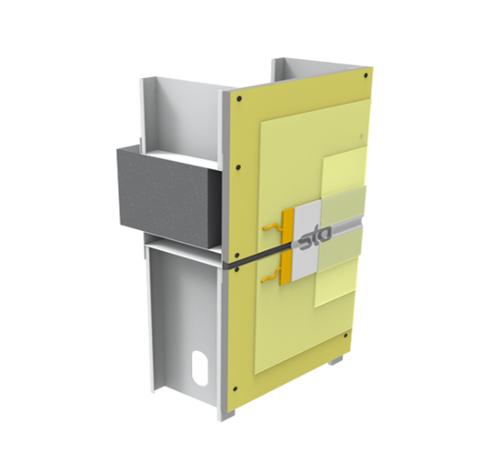
EPD for StoGuard® Transition Membrane StoGuard® Transition Membrane is a flexible air barrier membrane for use on vertical above grade wall construction over properly prepared concrete, concrete masonry (CMU), glass mat gypsum sheathing and Exterior or Exposure I wood-based sheathing.

2 Manufacturer Name Sto Corp. 3800 Camp Creek Parkway SW, Building 1400, Suite 120, Atlanta, GA 30331 www.stocorp.com | (800) 221-2397 EPD Program Operator Epsten Group 101 Marietta St. Suite 2600, Atlanta, GA 30303 www.epstengroup.com Compliance to ISO21930:2017 Yes Product Name StoGuard® Transition Membrane Product’s Intended Application and Use Flexible air barrier membrane Declaration Number 01-007 Date of Certification December 18th, 2019 Period of Validity 5 years from date of certification Functional Unit One square meter of covered substrate for 60 years Reference Service Life used in assessment 10 Years Overall Data Quality Assessment Score Good Manufacturing Location Wörschach, Austria LCA Software and Version Number GaBi 9.2.0.58 LCI Database and Version Number GaBi Database, Service Pack 39 ISO 21930: 2017 serves as the core PCR Independent verification of the declaration and data, according to ISO 21930:2017 and ISO 14025:2006 Internal External Kate McFeaters kmcfeaters@epstengroup.com This life cycle assessment was conducted in accordance with ISO 14044 and the reference PCR by: WAP Sustainability Consulting, LLC This life cycle assessment was independently verified in accordance with ISO 14044 and the reference PCR by: Kate McFeaters kmcfeaters@epstengroup.com Comparability In order to support comparative assertions, this EPD meets all comparability requirements stated in ISO 14025:2006. However, differences in certain assumptions, data quality, and variability between LCA data sets may still exist. As such, caution should be exercised when evaluating EPDs from different manufacturers, as the EPD results may not be entirely comparable. Any EPD comparison must be carried out at the building level per ISO 21930 guidelines. The results of this EPD reflect an average performance by the product and its actual impacts may vary on a case-to-case basis.
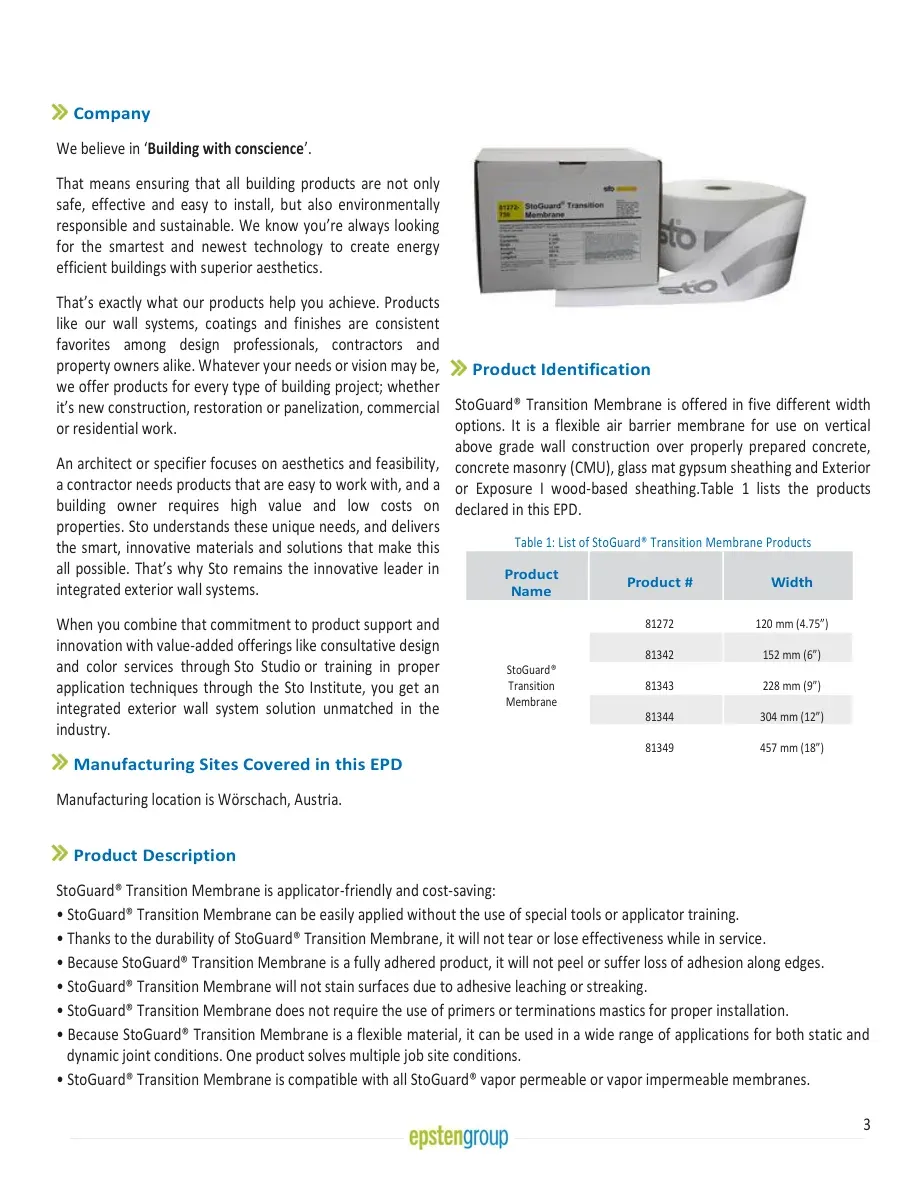
3 Company We believe in ‘Building with conscience’. That means ensuring that all building products are not only safe, effective and easy to install, but also environmentally responsible and sustainable. We know you’re always looking for the smartest and newest technology to create energy efficient buildings with superior aesthetics. That’s exactly what our products help you achieve. Products like our wall systems, coatings and finishes are consistent favorites among design professionals, contractors and property owners alike. Whatever your needs or vision may be, we offer products for every type of building project; whether it’s new construction, restoration or panelization, commercial or residential work. An architect or specifier focuses on aesthetics and feasibility, a contractor needs products that are easy to work with, and a building owner requires high value and low costs on properties. Sto understands these unique needs, and delivers the smart, innovative materials and solutions that make this all possible. That’s why Sto remains the innovative leader in integrated exterior wall systems. When you combine that commitment to product support and innovation with value-added offerings like consultative design and color services through Sto Studio or training in proper application techniques through the Sto Institute, you get an integrated exterior wall system solution unmatched in the industry. Manufacturing Sites Covered in this EPD Manufacturing location is Wörschach, Austria. Product Identification StoGuard® Transition Membrane is offered in five different width options. It is a flexible air barrier membrane for use on vertical above grade wall construction over properly prepared concrete, concrete masonry (CMU), glass mat gypsum sheathing and Exterior or Exposure I wood-based sheathing.Table 1 lists the products declared in this EPD. Table 1: List of StoGuard® Transition Membrane Products Product Name Product # Width StoGuard® Transition Membrane 81272 120 mm (4.75”) 81342 152 mm (6”) 81343 228 mm (9”) 81344 304 mm (12”) 81349 457 mm (18”) Product Description StoGuard® Transition Membrane is applicator-friendly and cost-saving: • StoGuard® Transition Membrane can be easily applied without the use of special tools or applicator training. • Thanks to the durability of StoGuard® Transition Membrane, it will not tear or lose effectiveness while in service. • Because StoGuard® Transition Membrane is a fully adhered product, it will not peel or suffer loss of adhesion along edges. • StoGuard® Transition Membrane will not stain surfaces due to adhesive leaching or streaking. • StoGuard® Transition Membrane does not require the use of primers or terminations mastics for proper installation. • Because StoGuard® Transition Membrane is a flexible material, it can be used in a wide range of applications for both static and dynamic joint conditions. One product solves multiple job site conditions. • StoGuard® Transition Membrane is compatible with all StoGuard® vapor permeable or vapor impermeable membranes.
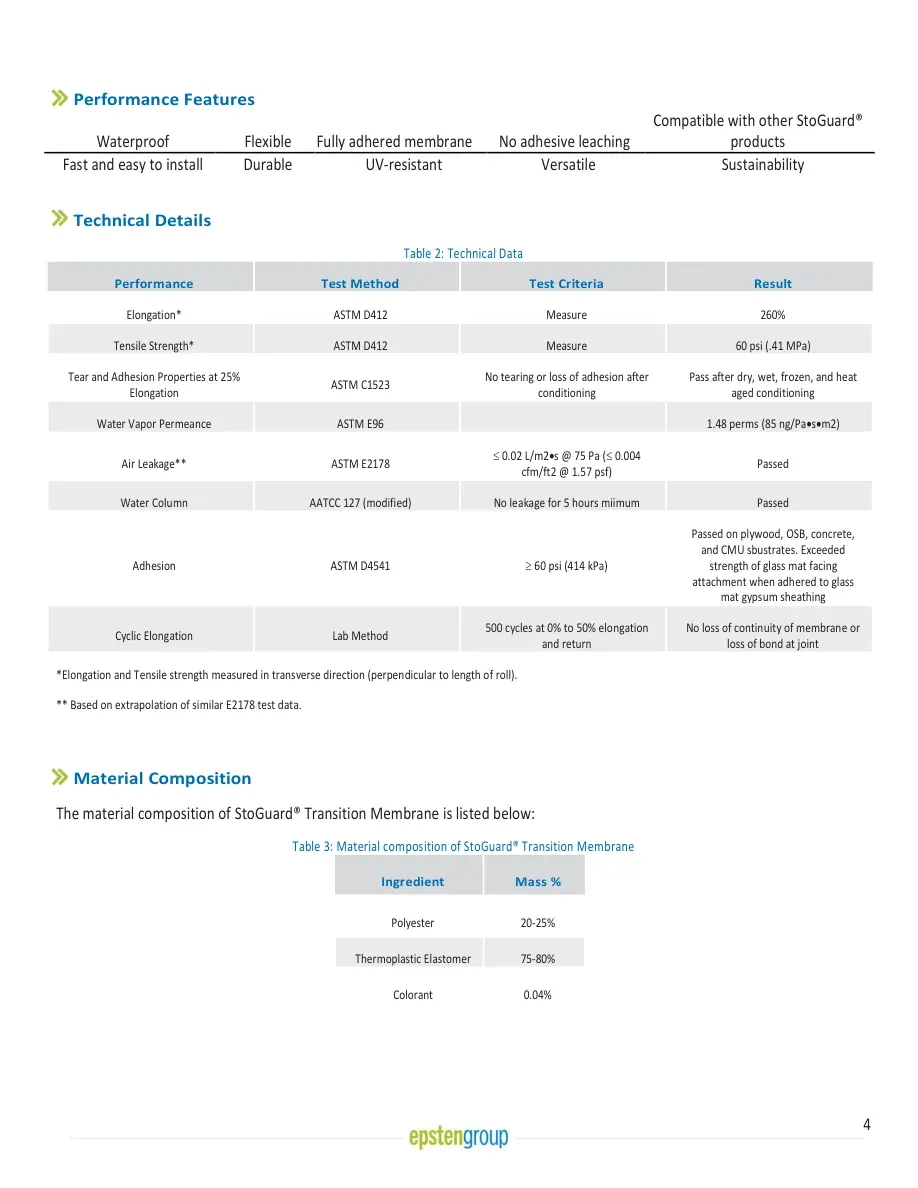
4 Performance Features Waterproof Flexible Fully adhered membrane No adhesive leaching Compatible with other StoGuard® products Fast and easy to install Durable UV-resistant Versatile Sustainability Technical Details Table 2: Technical Data Performance Test Method Test Criteria Result Elongation* ASTM D412 Measure 260% Tensile Strength* ASTM D412 Measure 60 psi (.41 MPa) Tear and Adhesion Properties at 25% Elongation ASTM C1523 No tearing or loss of adhesion after conditioning Pass after dry, wet, frozen, and heat aged conditioning Water Vapor Permeance ASTM E96 1.48 perms (85 ng/Pa•s•m2) Air Leakage** ASTM E2178 0.02 L/m2•s @ 75 Pa ( 0.004 cfm/ft2 @ 1.57 psf) Passed Water Column AATCC 127 (modified) No leakage for 5 hours miimum Passed Adhesion ASTM D4541 60 psi (414 kPa) Passed on plywood, OSB, concrete, and CMU sbustrates. Exceeded strength of glass mat facing attachment when adhered to glass mat gypsum sheathing Cyclic Elongation Lab Method 500 cycles at 0% to 50% elongation and return No loss of continuity of membrane or loss of bond at joint *Elongation and Tensile strength measured in transverse direction (perpendicular to length of roll). ** Based on extrapolation of similar E2178 test data. Material Composition The material composition of StoGuard® Transition Membrane is listed below: Table 3: Material composition of StoGuard® Transition Membrane Ingredient Mass % Polyester 20-25% Thermoplastic Elastomer 75-80% Colorant 0.04%
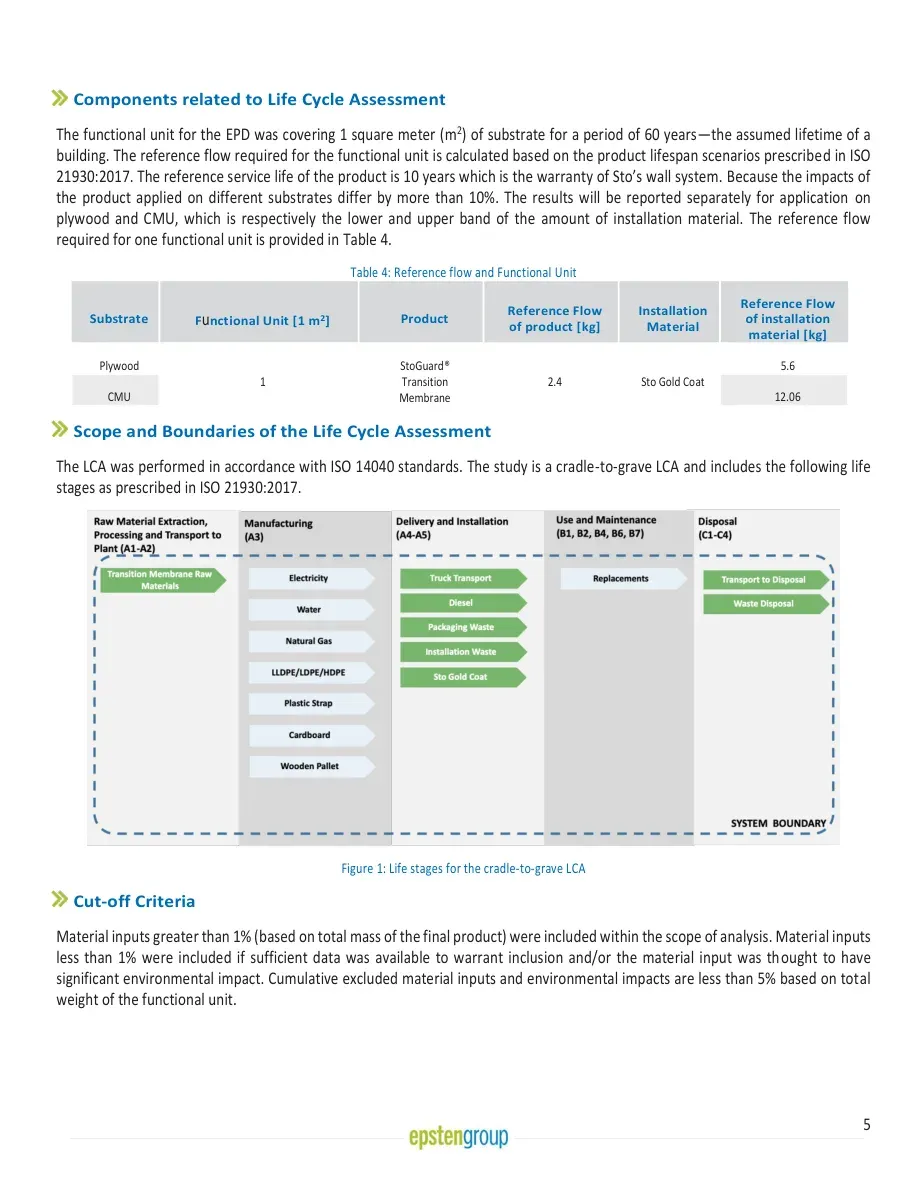
5 Components related to Life Cycle Assessment The functional unit for the EPD was covering 1 square meter (m2) of substrate for a period of 60 years—the assumed lifetime of a building. The reference flow required for the functional unit is calculated based on the product lifespan scenarios prescribed in ISO 21930:2017. The reference service life of the product is 10 years which is the warranty of Sto’s wall system. Because the impacts of the product applied on different substrates differ by more than 10%. The results will be reported separately for application on plywood and CMU, which is respectively the lower and upper band of the amount of installation material. The reference flow required for one functional unit is provided in Table 4. Table 4: Reference flow and Functional Unit Substrate Functional Unit [1 m2] Product Reference Flow of product [kg] Installation Material Reference Flow of installation material [kg] Plywood 1 StoGuard® Transition Membrane 2.4 Sto Gold Coat 5.6 CMU 12.06 Scope and Boundaries of the Life Cycle Assessment The LCA was performed in accordance with ISO 14040 standards. The study is a cradle-to-grave LCA and includes the following life stages as prescribed in ISO 21930:2017. Figure 1: Life stages for the cradle-to-grave LCA Cut-off Criteria Material inputs greater than 1% (based on total mass of the final product) were included within the scope of analysis. Material inputs less than 1% were included if sufficient data was available to warrant inclusion and/or the material input was thought to have significant environmental impact. Cumulative excluded material inputs and environmental impacts are less than 5% based on total weight of the functional unit.
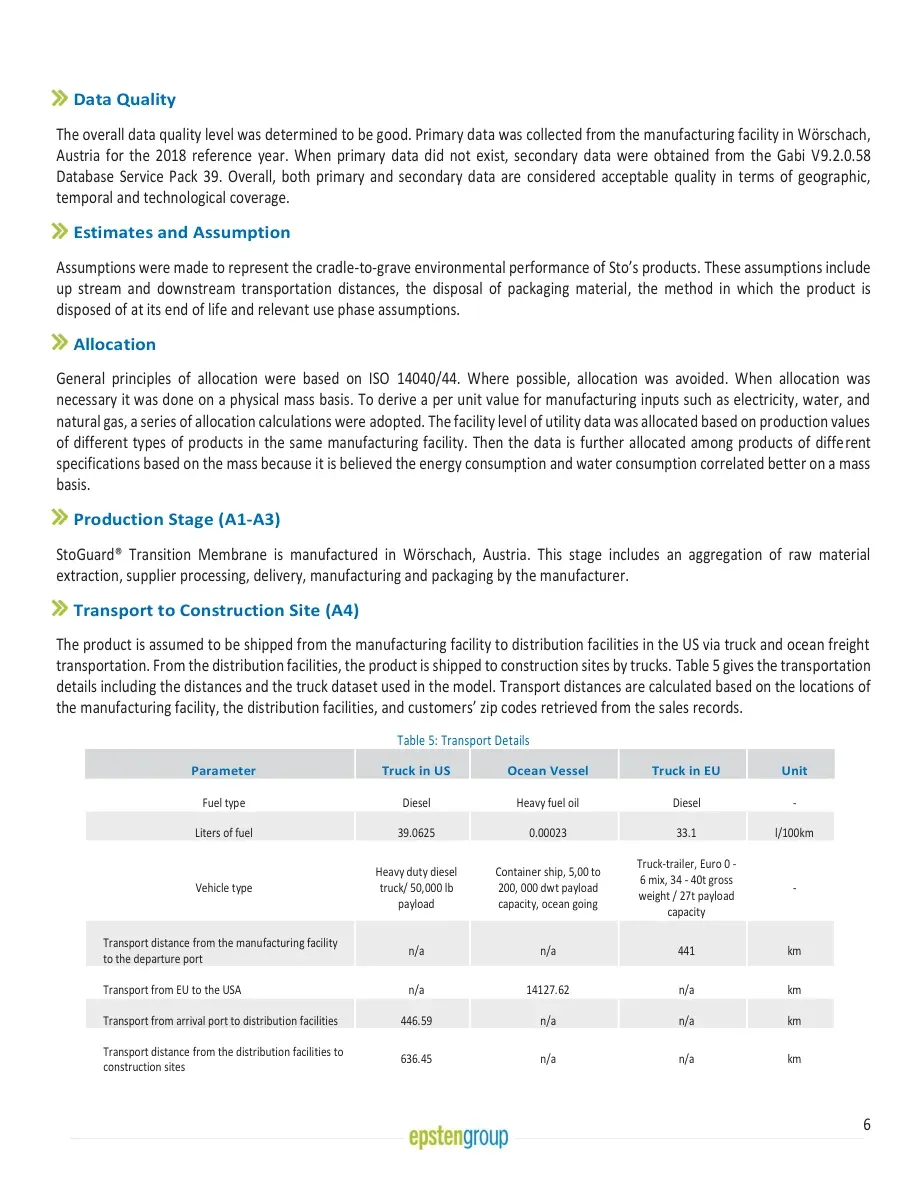
6 Data Quality The overall data quality level was determined to be good. Primary data was collected from the manufacturing facility in Wörschach, Austria for the 2018 reference year. When primary data did not exist, secondary data were obtained from the Gabi V9.2.0.58 Database Service Pack 39. Overall, both primary and secondary data are considered acceptable quality in terms of geographic, temporal and technological coverage. Estimates and Assumption Assumptions were made to represent the cradle-to-grave environmental performance of Sto’s products. These assumptions include up stream and downstream transportation distances, the disposal of packaging material, the method in which the product is disposed of at its end of life and relevant use phase assumptions. Allocation General principles of allocation were based on ISO 14040/44. Where possible, allocation was avoided. When allocation was necessary it was done on a physical mass basis. To derive a per unit value for manufacturing inputs such as electricity, water, and natural gas, a series of allocation calculations were adopted. The facility level of utility data was allocated based on production values of different types of products in the same manufacturing facility. Then the data is further allocated among products of different specifications based on the mass because it is believed the energy consumption and water consumption correlated better on a mass basis. Production Stage (A1-A3) StoGuard® Transition Membrane is manufactured in Wörschach, Austria. This stage includes an aggregation of raw material extraction, supplier processing, delivery, manufacturing and packaging by the manufacturer. Transport to Construction Site (A4) The product is assumed to be shipped from the manufacturing facility to distribution facilities in the US via truck and ocean freight transportation. From the distribution facilities, the product is shipped to construction sites by trucks. Table 5 gives the transportation details including the distances and the truck dataset used in the model. Transport distances are calculated based on the locations of the manufacturing facility, the distribution facilities, and customers’ zip codes retrieved from the sales records. Table 5: Transport Details Parameter Truck in US Ocean Vessel Truck in EU Unit Fuel type Diesel Heavy fuel oil Diesel - Liters of fuel 39.0625 0.00023 33.1 l/100km Vehicle type Heavy duty diesel truck/ 50,000 lb payload Container ship, 5,00 to 200, 000 dwt payload capacity, ocean going Truck-trailer, Euro 0 - 6 mix, 34 - 40t gross weight / 27t payload capacity - Transport distance from the manufacturing facility to the departure port n/a n/a 441 km Transport from EU to the USA n/a 14127.62 n/a km Transport from arrival port to distribution facilities 446.59 n/a n/a km Transport distance from the distribution facilities to construction sites 636.45 n/a n/a km
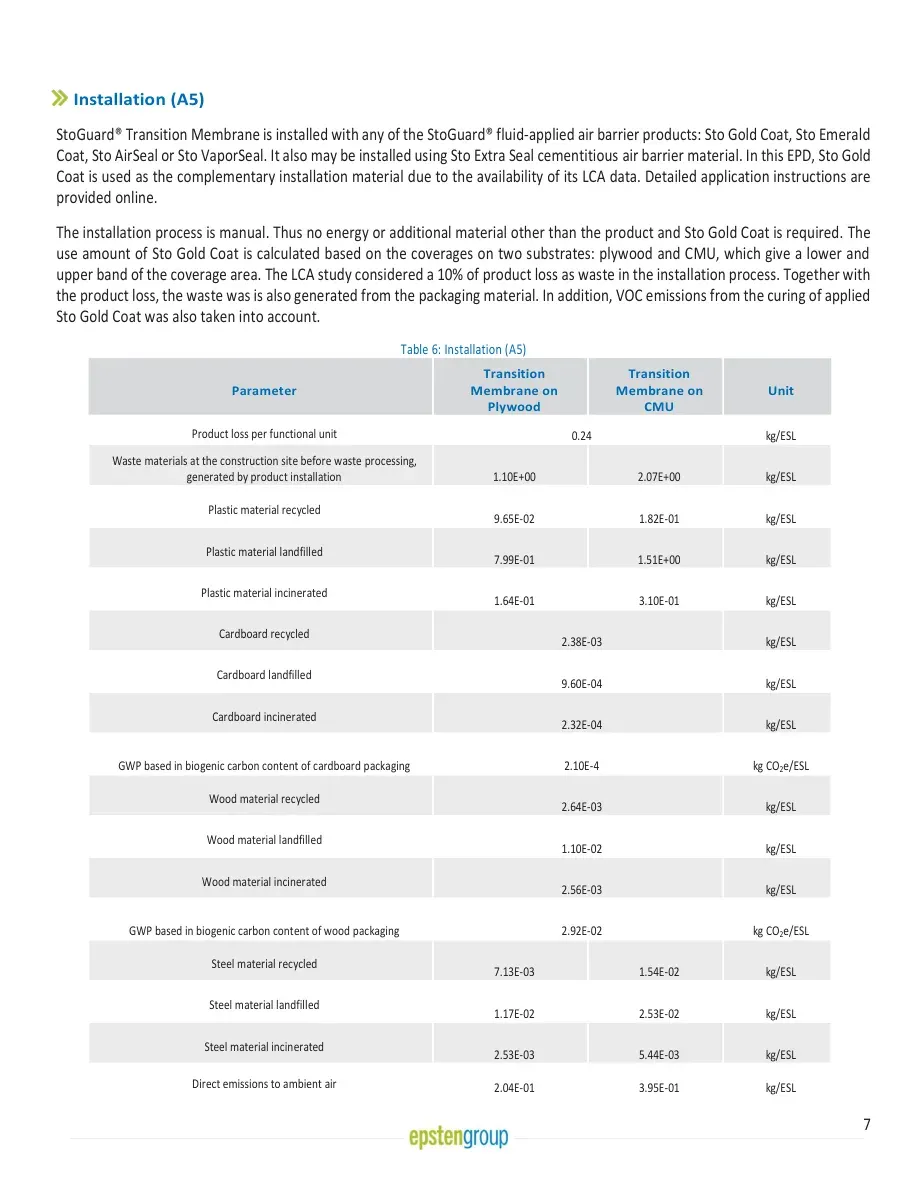
7 Installation (A5) StoGuard® Transition Membrane is installed with any of the StoGuard® fluid-applied air barrier products: Sto Gold Coat, Sto Emerald Coat, Sto AirSeal or Sto VaporSeal. It also may be installed using Sto Extra Seal cementitious air barrier material. In this EPD, Sto Gold Coat is used as the complementary installation material due to the availability of its LCA data. Detailed application instructions are provided online. The installation process is manual. Thus no energy or additional material other than the product and Sto Gold Coat is required. The use amount of Sto Gold Coat is calculated based on the coverages on two substrates: plywood and CMU, which give a lower and upper band of the coverage area. The LCA study considered a 10% of product loss as waste in the installation process. Together with the product loss, the waste was is also generated from the packaging material. In addition, VOC emissions from the curing of applied Sto Gold Coat was also taken into account. Table 6: Installation (A5) Parameter Transition Membrane on Plywood Transition Membrane on CMU Unit Product loss per functional unit 0.24 kg/ESL Waste materials at the construction site before waste processing, generated by product installation 1.10E+00 2.07E+00 kg/ESL Plastic material recycled 9.65E-02 1.82E-01 kg/ESL Plastic material landfilled 7.99E-01 1.51E+00 kg/ESL Plastic material incinerated 1.64E-01 3.10E-01 kg/ESL Cardboard recycled 2.38E-03 kg/ESL Cardboard landfilled 9.60E-04 kg/ESL Cardboard incinerated 2.32E-04 kg/ESL GWP based in biogenic carbon content of cardboard packaging 2.10E-4 kg CO2e/ESL Wood material recycled 2.64E-03 kg/ESL Wood material landfilled 1.10E-02 kg/ESL Wood material incinerated 2.56E-03 kg/ESL GWP based in biogenic carbon content of wood packaging 2.92E-02 kg CO2e/ESL Steel material recycled 7.13E-03 1.54E-02 kg/ESL Steel material landfilled 1.17E-02 2.53E-02 kg/ESL Steel material incinerated 2.53E-03 5.44E-03 kg/ESL Direct emissions to ambient air 2.04E-01 3.95E-01 kg/ESL
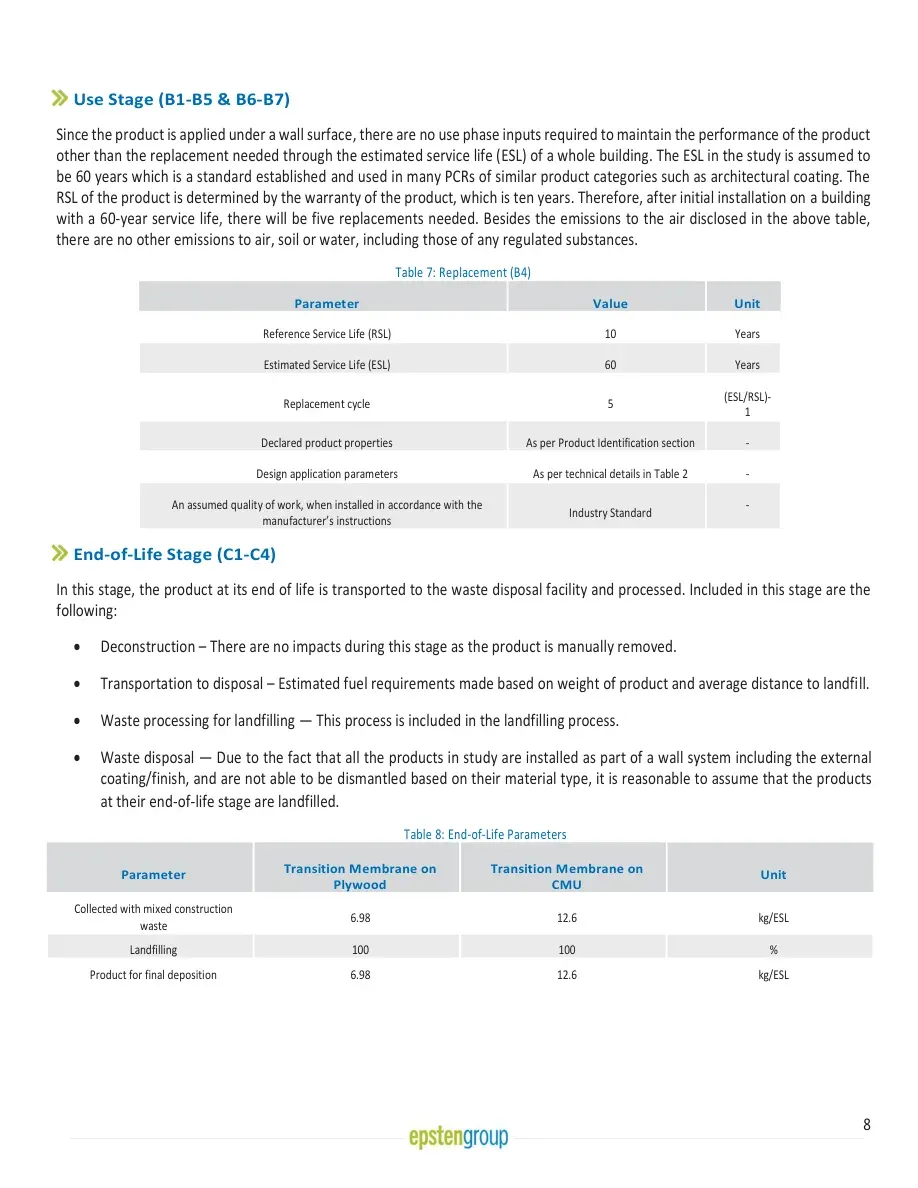
8 Use Stage (B1-B5 & B6-B7) Since the product is applied under a wall surface, there are no use phase inputs required to maintain the performance of the product other than the replacement needed through the estimated service life (ESL) of a whole building. The ESL in the study is assumed to be 60 years which is a standard established and used in many PCRs of similar product categories such as architectural coating. The RSL of the product is determined by the warranty of the product, which is ten years. Therefore, after initial installation on a building with a 60-year service life, there will be five replacements needed. Besides the emissions to the air disclosed in the above table, there are no other emissions to air, soil or water, including those of any regulated substances. Table 7: Replacement (B4) Parameter Value Unit Reference Service Life (RSL) 10 Years Estimated Service Life (ESL) 60 Years Replacement cycle 5 (ESL/RSL)-1 Declared product properties As per Product Identification section - Design application parameters As per technical details in Table 2 - An assumed quality of work, when installed in accordance with the manufacturer’s instructions Industry Standard - End-of-Life Stage (C1-C4) In this stage, the product at its end of life is transported to the waste disposal facility and processed. Included in this stage are the following: • Deconstruction – There are no impacts during this stage as the product is manually removed. • Transportation to disposal – Estimated fuel requirements made based on weight of product and average distance to landfill. • Waste processing for landfilling — This process is included in the landfilling process. • Waste disposal — Due to the fact that all the products in study are installed as part of a wall system including the external coating/finish, and are not able to be dismantled based on their material type, it is reasonable to assume that the products at their end-of-life stage are landfilled. Table 8: End-of-Life Parameters Parameter Transition Membrane on Plywood Transition Membrane on CMU Unit Collected with mixed construction waste 6.98 12.6 kg/ESL Landfilling 100 100 % Product for final deposition 6.98 12.6 kg/ESL
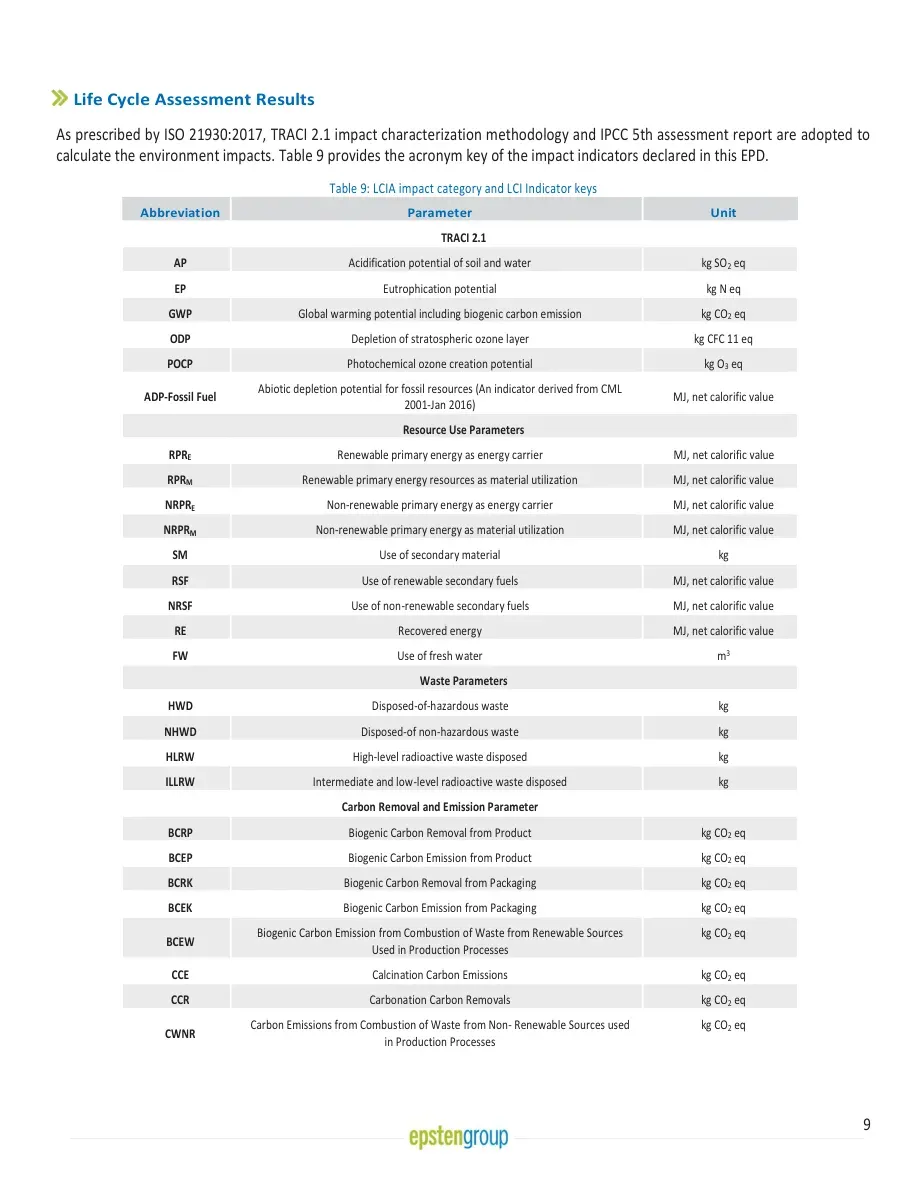
9 Life Cycle Assessment Results As prescribed by ISO 21930:2017, TRACI 2.1 impact characterization methodology and IPCC 5th assessment report are adopted to calculate the environment impacts. Table 9 provides the acronym key of the impact indicators declared in this EPD. Table 9: LCIA impact category and LCI Indicator keys Abbreviation Parameter Unit TRACI 2.1 AP Acidification potential of soil and water kg SO2 eq EP Eutrophication potential kg N eq GWP Global warming potential including biogenic carbon emission kg CO2 eq ODP Depletion of stratospheric ozone layer kg CFC 11 eq POCP Photochemical ozone creation potential kg O3 eq ADP-Fossil Fuel Abiotic depletion potential for fossil resources (An indicator derived from CML 2001-Jan 2016) MJ, net calorific value Resource Use Parameters RPRE Renewable primary energy as energy carrier MJ, net calorific value RPRM Renewable primary energy resources as material utilization MJ, net calorific value NRPRE Non-renewable primary energy as energy carrier MJ, net calorific value NRPRM Non-renewable primary energy as material utilization MJ, net calorific value SM Use of secondary material kg RSF Use of renewable secondary fuels MJ, net calorific value NRSF Use of non-renewable secondary fuels MJ, net calorific value RE Recovered energy MJ, net calorific value FW Use of fresh water m3 Waste Parameters HWD Disposed-of-hazardous waste kg NHWD Disposed-of non-hazardous waste kg HLRW High-level radioactive waste disposed kg ILLRW Intermediate and low-level radioactive waste disposed kg Carbon Removal and Emission Parameter BCRP Biogenic Carbon Removal from Product kg CO2 eq BCEP Biogenic Carbon Emission from Product kg CO2 eq BCRK Biogenic Carbon Removal from Packaging kg CO2 eq BCEK Biogenic Carbon Emission from Packaging kg CO2 eq BCEW Biogenic Carbon Emission from Combustion of Waste from Renewable Sources Used in Production Processes kg CO2 eq CCE Calcination Carbon Emissions kg CO2 eq CCR Carbonation Carbon Removals kg CO2 eq CWNR Carbon Emissions from Combustion of Waste from Non- Renewable Sources used in Production Processes kg CO2 eq
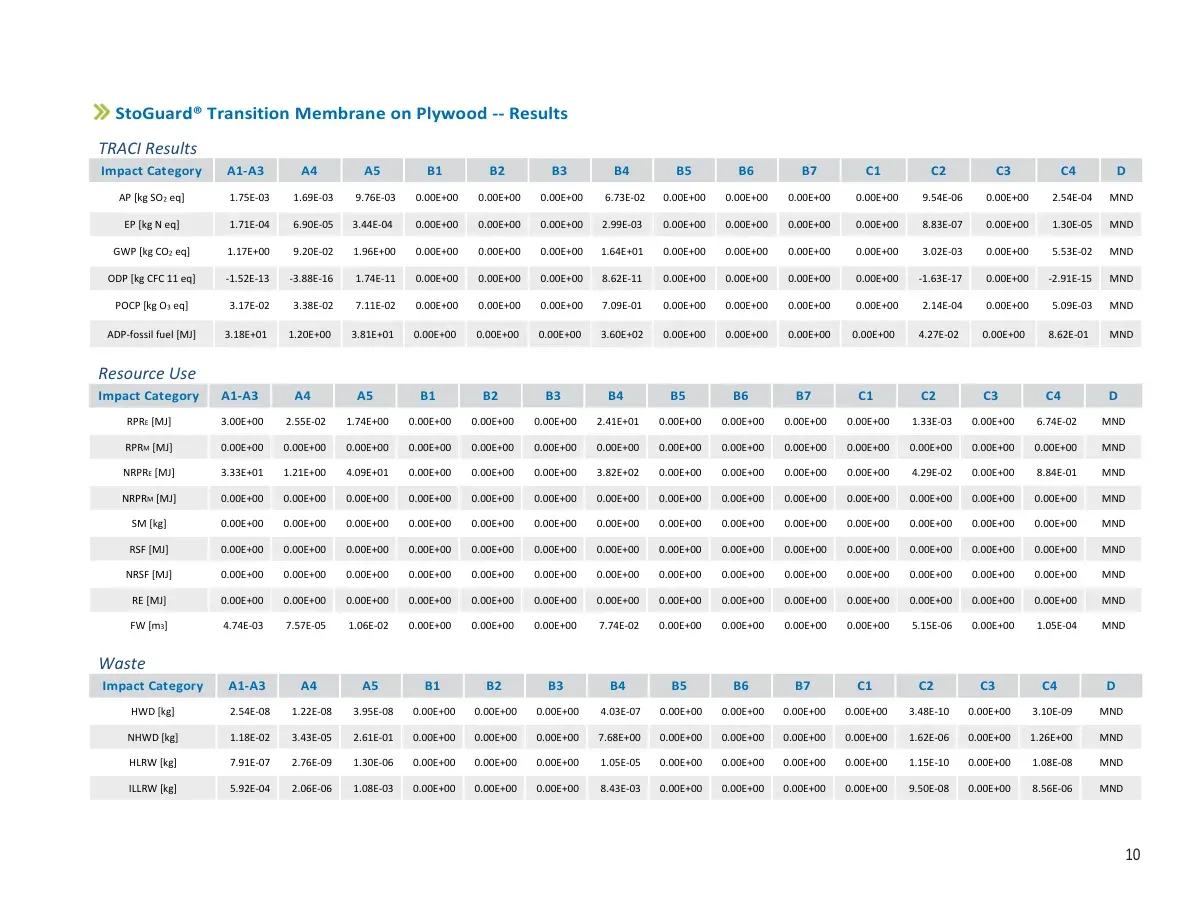
10 StoGuard® Transition Membrane on Plywood -- Results TRACI Results Impact Category A1-A3 A4 A5 B1 B2 B3 B4 B5 B6 B7 C1 C2 C3 C4 D AP [kg SO2 eq] 1.75E-03 1.69E-03 9.76E-03 0.00E+00 0.00E+00 0.00E+00 6.73E-02 0.00E+00 0.00E+00 0.00E+00 0.00E+00 9.54E-06 0.00E+00 2.54E-04 MND EP [kg N eq] 1.71E-04 6.90E-05 3.44E-04 0.00E+00 0.00E+00 0.00E+00 2.99E-03 0.00E+00 0.00E+00 0.00E+00 0.00E+00 8.83E-07 0.00E+00 1.30E-05 MND GWP [kg CO2 eq] 1.17E+00 9.20E-02 1.96E+00 0.00E+00 0.00E+00 0.00E+00 1.64E+01 0.00E+00 0.00E+00 0.00E+00 0.00E+00 3.02E-03 0.00E+00 5.53E-02 MND ODP [kg CFC 11 eq] -1.52E-13 -3.88E-16 1.74E-11 0.00E+00 0.00E+00 0.00E+00 8.62E-11 0.00E+00 0.00E+00 0.00E+00 0.00E+00 -1.63E-17 0.00E+00 -2.91E-15 MND POCP [kg O3 eq] 3.17E-02 3.38E-02 7.11E-02 0.00E+00 0.00E+00 0.00E+00 7.09E-01 0.00E+00 0.00E+00 0.00E+00 0.00E+00 2.14E-04 0.00E+00 5.09E-03 MND ADP-fossil fuel [MJ] 3.18E+01 1.20E+00 3.81E+01 0.00E+00 0.00E+00 0.00E+00 3.60E+02 0.00E+00 0.00E+00 0.00E+00 0.00E+00 4.27E-02 0.00E+00 8.62E-01 MND Resource Use Impact Category A1-A3 A4 A5 B1 B2 B3 B4 B5 B6 B7 C1 C2 C3 C4 D RPRE [MJ] 3.00E+00 2.55E-02 1.74E+00 0.00E+00 0.00E+00 0.00E+00 2.41E+01 0.00E+00 0.00E+00 0.00E+00 0.00E+00 1.33E-03 0.00E+00 6.74E-02 MND RPRM [MJ] 0.00E+00 0.00E+00 0.00E+00 0.00E+00 0.00E+00 0.00E+00 0.00E+00 0.00E+00 0.00E+00 0.00E+00 0.00E+00 0.00E+00 0.00E+00 0.00E+00 MND NRPRE [MJ] 3.33E+01 1.21E+00 4.09E+01 0.00E+00 0.00E+00 0.00E+00 3.82E+02 0.00E+00 0.00E+00 0.00E+00 0.00E+00 4.29E-02 0.00E+00 8.84E-01 MND NRPRM [MJ] 0.00E+00 0.00E+00 0.00E+00 0.00E+00 0.00E+00 0.00E+00 0.00E+00 0.00E+00 0.00E+00 0.00E+00 0.00E+00 0.00E+00 0.00E+00 0.00E+00 MND SM [kg] 0.00E+00 0.00E+00 0.00E+00 0.00E+00 0.00E+00 0.00E+00 0.00E+00 0.00E+00 0.00E+00 0.00E+00 0.00E+00 0.00E+00 0.00E+00 0.00E+00 MND RSF [MJ] 0.00E+00 0.00E+00 0.00E+00 0.00E+00 0.00E+00 0.00E+00 0.00E+00 0.00E+00 0.00E+00 0.00E+00 0.00E+00 0.00E+00 0.00E+00 0.00E+00 MND NRSF [MJ] 0.00E+00 0.00E+00 0.00E+00 0.00E+00 0.00E+00 0.00E+00 0.00E+00 0.00E+00 0.00E+00 0.00E+00 0.00E+00 0.00E+00 0.00E+00 0.00E+00 MND RE [MJ] 0.00E+00 0.00E+00 0.00E+00 0.00E+00 0.00E+00 0.00E+00 0.00E+00 0.00E+00 0.00E+00 0.00E+00 0.00E+00 0.00E+00 0.00E+00 0.00E+00 MND FW [m3] 4.74E-03 7.57E-05 1.06E-02 0.00E+00 0.00E+00 0.00E+00 7.74E-02 0.00E+00 0.00E+00 0.00E+00 0.00E+00 5.15E-06 0.00E+00 1.05E-04 MND Waste Impact Category A1-A3 A4 A5 B1 B2 B3 B4 B5 B6 B7 C1 C2 C3 C4 D HWD [kg] 2.54E-08 1.22E-08 3.95E-08 0.00E+00 0.00E+00 0.00E+00 4.03E-07 0.00E+00 0.00E+00 0.00E+00 0.00E+00 3.48E-10 0.00E+00 3.10E-09 MND NHWD [kg] 1.18E-02 3.43E-05 2.61E-01 0.00E+00 0.00E+00 0.00E+00 7.68E+00 0.00E+00 0.00E+00 0.00E+00 0.00E+00 1.62E-06 0.00E+00 1.26E+00 MND HLRW [kg] 7.91E-07 2.76E-09 1.30E-06 0.00E+00 0.00E+00 0.00E+00 1.05E-05 0.00E+00 0.00E+00 0.00E+00 0.00E+00 1.15E-10 0.00E+00 1.08E-08 MND ILLRW [kg] 5.92E-04 2.06E-06 1.08E-03 0.00E+00 0.00E+00 0.00E+00 8.43E-03 0.00E+00 0.00E+00 0.00E+00 0.00E+00 9.50E-08 0.00E+00 8.56E-06 MND
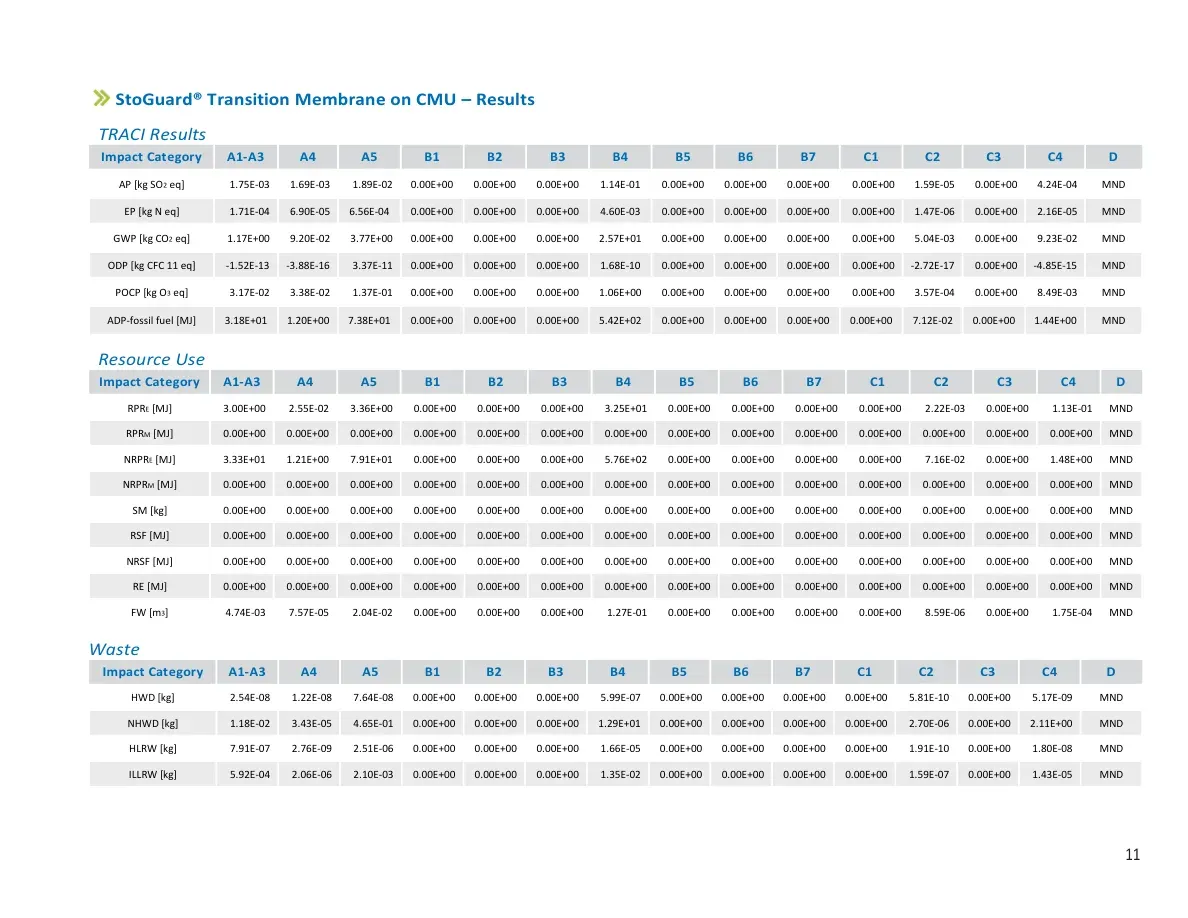
11 StoGuard® Transition Membrane on CMU – Results TRACI Results Impact Category A1-A3 A4 A5 B1 B2 B3 B4 B5 B6 B7 C1 C2 C3 C4 D AP [kg SO2 eq] 1.75E-03 1.69E-03 1.89E-02 0.00E+00 0.00E+00 0.00E+00 1.14E-01 0.00E+00 0.00E+00 0.00E+00 0.00E+00 1.59E-05 0.00E+00 4.24E-04 MND EP [kg N eq] 1.71E-04 6.90E-05 6.56E-04 0.00E+00 0.00E+00 0.00E+00 4.60E-03 0.00E+00 0.00E+00 0.00E+00 0.00E+00 1.47E-06 0.00E+00 2.16E-05 MND GWP [kg CO2 eq] 1.17E+00 9.20E-02 3.77E+00 0.00E+00 0.00E+00 0.00E+00 2.57E+01 0.00E+00 0.00E+00 0.00E+00 0.00E+00 5.04E-03 0.00E+00 9.23E-02 MND ODP [kg CFC 11 eq] -1.52E-13 -3.88E-16 3.37E-11 0.00E+00 0.00E+00 0.00E+00 1.68E-10 0.00E+00 0.00E+00 0.00E+00 0.00E+00 -2.72E-17 0.00E+00 -4.85E-15 MND POCP [kg O3 eq] 3.17E-02 3.38E-02 1.37E-01 0.00E+00 0.00E+00 0.00E+00 1.06E+00 0.00E+00 0.00E+00 0.00E+00 0.00E+00 3.57E-04 0.00E+00 8.49E-03 MND ADP-fossil fuel [MJ] 3.18E+01 1.20E+00 7.38E+01 0.00E+00 0.00E+00 0.00E+00 5.42E+02 0.00E+00 0.00E+00 0.00E+00 0.00E+00 7.12E-02 0.00E+00 1.44E+00 MND Resource Use Impact Category A1-A3 A4 A5 B1 B2 B3 B4 B5 B6 B7 C1 C2 C3 C4 D RPRE [MJ] 3.00E+00 2.55E-02 3.36E+00 0.00E+00 0.00E+00 0.00E+00 3.25E+01 0.00E+00 0.00E+00 0.00E+00 0.00E+00 2.22E-03 0.00E+00 1.13E-01 MND RPRM [MJ] 0.00E+00 0.00E+00 0.00E+00 0.00E+00 0.00E+00 0.00E+00 0.00E+00 0.00E+00 0.00E+00 0.00E+00 0.00E+00 0.00E+00 0.00E+00 0.00E+00 MND NRPRE [MJ] 3.33E+01 1.21E+00 7.91E+01 0.00E+00 0.00E+00 0.00E+00 5.76E+02 0.00E+00 0.00E+00 0.00E+00 0.00E+00 7.16E-02 0.00E+00 1.48E+00 MND NRPRM [MJ] 0.00E+00 0.00E+00 0.00E+00 0.00E+00 0.00E+00 0.00E+00 0.00E+00 0.00E+00 0.00E+00 0.00E+00 0.00E+00 0.00E+00 0.00E+00 0.00E+00 MND SM [kg] 0.00E+00 0.00E+00 0.00E+00 0.00E+00 0.00E+00 0.00E+00 0.00E+00 0.00E+00 0.00E+00 0.00E+00 0.00E+00 0.00E+00 0.00E+00 0.00E+00 MND RSF [MJ] 0.00E+00 0.00E+00 0.00E+00 0.00E+00 0.00E+00 0.00E+00 0.00E+00 0.00E+00 0.00E+00 0.00E+00 0.00E+00 0.00E+00 0.00E+00 0.00E+00 MND NRSF [MJ] 0.00E+00 0.00E+00 0.00E+00 0.00E+00 0.00E+00 0.00E+00 0.00E+00 0.00E+00 0.00E+00 0.00E+00 0.00E+00 0.00E+00 0.00E+00 0.00E+00 MND RE [MJ] 0.00E+00 0.00E+00 0.00E+00 0.00E+00 0.00E+00 0.00E+00 0.00E+00 0.00E+00 0.00E+00 0.00E+00 0.00E+00 0.00E+00 0.00E+00 0.00E+00 MND FW [m3] 4.74E-03 7.57E-05 2.04E-02 0.00E+00 0.00E+00 0.00E+00 1.27E-01 0.00E+00 0.00E+00 0.00E+00 0.00E+00 8.59E-06 0.00E+00 1.75E-04 MND Waste Impact Category A1-A3 A4 A5 B1 B2 B3 B4 B5 B6 B7 C1 C2 C3 C4 D HWD [kg] 2.54E-08 1.22E-08 7.64E-08 0.00E+00 0.00E+00 0.00E+00 5.99E-07 0.00E+00 0.00E+00 0.00E+00 0.00E+00 5.81E-10 0.00E+00 5.17E-09 MND NHWD [kg] 1.18E-02 3.43E-05 4.65E-01 0.00E+00 0.00E+00 0.00E+00 1.29E+01 0.00E+00 0.00E+00 0.00E+00 0.00E+00 2.70E-06 0.00E+00 2.11E+00 MND HLRW [kg] 7.91E-07 2.76E-09 2.51E-06 0.00E+00 0.00E+00 0.00E+00 1.66E-05 0.00E+00 0.00E+00 0.00E+00 0.00E+00 1.91E-10 0.00E+00 1.80E-08 MND ILLRW [kg] 5.92E-04 2.06E-06 2.10E-03 0.00E+00 0.00E+00 0.00E+00 1.35E-02 0.00E+00 0.00E+00 0.00E+00 0.00E+00 1.59E-07 0.00E+00 1.43E-05 MND
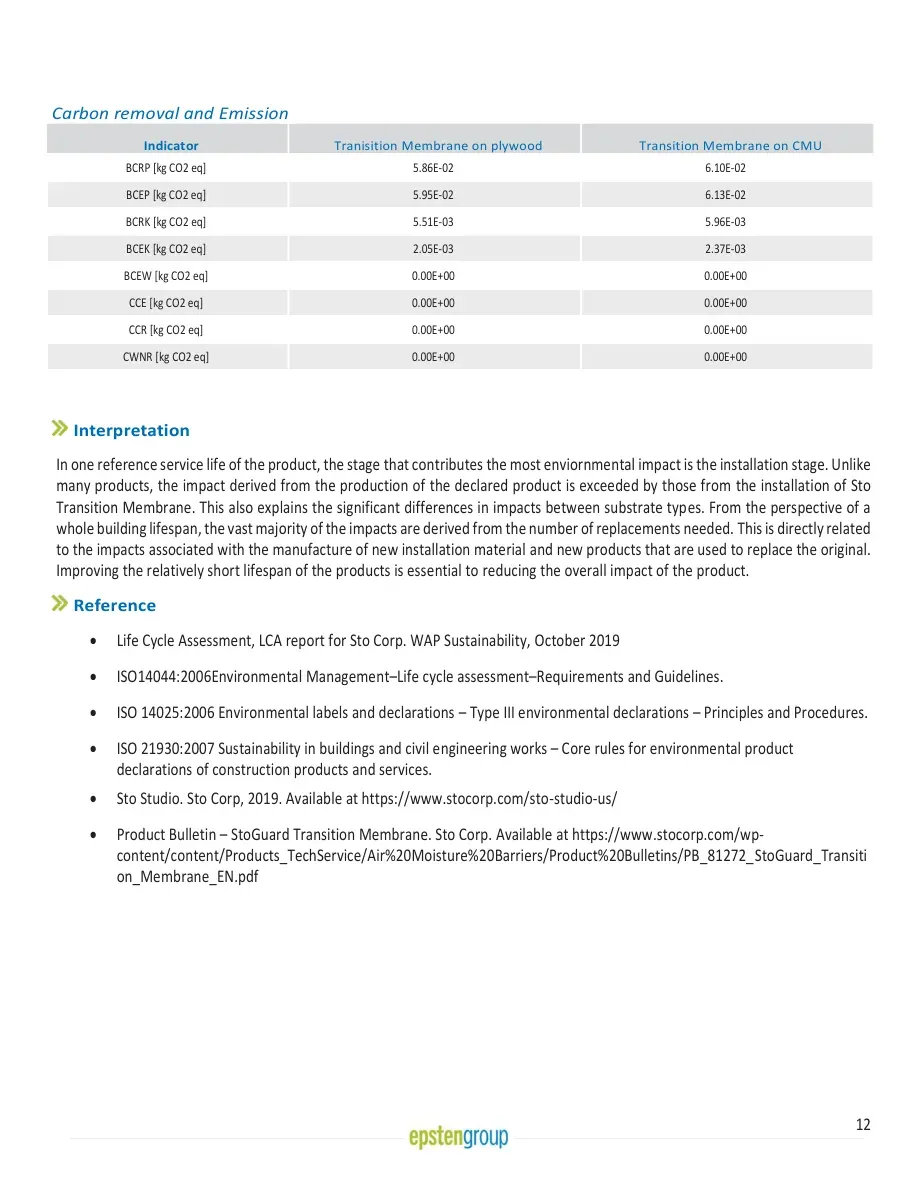
12 Carbon removal and Emission Indicator Tranisition Membrane on plywood Transition Membrane on CMU BCRP [kg CO2 eq] 5.86E-02 6.10E-02 BCEP [kg CO2 eq] 5.95E-02 6.13E-02 BCRK [kg CO2 eq] 5.51E-03 5.96E-03 BCEK [kg CO2 eq] 2.05E-03 2.37E-03 BCEW [kg CO2 eq] 0.00E+00 0.00E+00 CCE [kg CO2 eq] 0.00E+00 0.00E+00 CCR [kg CO2 eq] 0.00E+00 0.00E+00 CWNR [kg CO2 eq] 0.00E+00 0.00E+00 Interpretation In one reference service life of the product, the stage that contributes the most enviornmental impact is the installation stage. Unlike many products, the impact derived from the production of the declared product is exceeded by those from the installation of Sto Transition Membrane. This also explains the significant differences in impacts between substrate types. From the perspective of a whole building lifespan, the vast majority of the impacts are derived from the number of replacements needed. This is directly related to the impacts associated with the manufacture of new installation material and new products that are used to replace the original. Improving the relatively short lifespan of the products is essential to reducing the overall impact of the product. Reference • Life Cycle Assessment, LCA report for Sto Corp. WAP Sustainability, October 2019 • ISO14044:2006Environmental Management–Life cycle assessment–Requirements and Guidelines. • ISO 14025:2006 Environmental labels and declarations – Type III environmental declarations – Principles and Procedures. • ISO 21930:2007 Sustainability in buildings and civil engineering works – Core rules for environmental product declarations of construction products and services. • Sto Studio. Sto Corp, 2019. Available at https://www.stocorp.com/sto-studio-us/ • Product Bulletin – StoGuard Transition Membrane. Sto Corp. Available at https://www.stocorp.com/wp-content/content/Products_TechService/Air%20Moisture%20Barriers/Product%20Bulletins/PB_81272_StoGuard_Transition_Membrane_EN.pdf